Digital twin
A photoreal, navigable 3D model of the whole property. Pan, zoom and walk through it in a browser, no app install.
A drone flies the roof, Meta Ray-Ban glasses walk the inside, a phone catches the detail. We fuse all three into a single 3D model, then AI flags every crack, stain, spall and missing tile in place.
From a single fused capture, the AI produces a navigable 3D model, every defect flagged on it, and a shareable condition report.
A photoreal, navigable 3D model of the whole property. Pan, zoom and walk through it in a browser, no app install.
Every crack, spall, stain and missing tile auto-flagged, labeled and pinned to its exact spot on the model.
A shareable report: each defect with its photo, location, severity and AI confidence. Ready for your file, your client or your insurer.
The drone covers the outside. A smart-glasses or smartphone pass captures every room. Same 3D model. Same defect detection. Same shareable link.
Drone, Meta Ray-Ban glasses and phone aren't alternatives; they're layers. Together they cover roof to subfloor, then fuse into one navigable 3D model with georeferenced defect markers.
Best for roof + upper facade. A 30-min flight at three altitudes produces ~1,000 RGB frames.
Ego-perspective ground-level capture. Hands-free walkthrough of interior + close-up details.
Lowest barrier. iPhone Pro's LiDAR sensor adds depth priors; mid-range Android still works.
Drone, Meta Ray-Ban glasses and a phone each capture what the others miss. The pipeline fuses them into a single navigable 3D model with every defect pinned in place.
Drone · Meta Ray-Ban · phone
Three cameras, three zones. The drone flies the roof and upper facade; Meta Ray-Ban glasses walk the interior and tight spaces hands-free; a phone grabs close-ups of anything that needs detail. One property, one session.
COLMAP structure-from-motion
The step that makes it one model. Structure-from-motion solves every frame from all three devices into a single shared coordinate frame, so aerial, ego-level and close-up imagery line up to the millimetre.
Gaussian Splatting (gsplat) + PGSR mesh
A photoreal 3D Gaussian Splat you can navigate in a browser, plus a PGSR mesh for measurement-grade geometry: 5 to 15 mm wall error against LiDAR ground truth.
YOLOv11-seg + SAM 2
Defects are segmented on the flat source frames, then lifted into the 3D model through the shared camera geometry from step 2, so every crack, spall and stain lands at its exact position on the wall.
Interactive 3D + annotated report
A browser link: pan, zoom, and click any marker for the source photo, AI confidence and note. Re-capture at 6 / 12 / 24 months for an automatic "what changed" diff on the same 3D scaffold.
Trained on CUBIT-InSeg, SDNET2018 and AU-specific building datasets. Each class has a published accuracy benchmark.
Concrete, masonry, render. Measured to nearest 2 mm.
Surface loss on concrete and brickwork.
Steel, exposed rebar, gutters, fasteners.
Roof, facade, floor: anywhere with a uniform pattern.
Staining, efflorescence, soft-edge moisture marks.
Bubbling paint, blown render, peeling coatings.
Trees and growth contacting the building envelope.
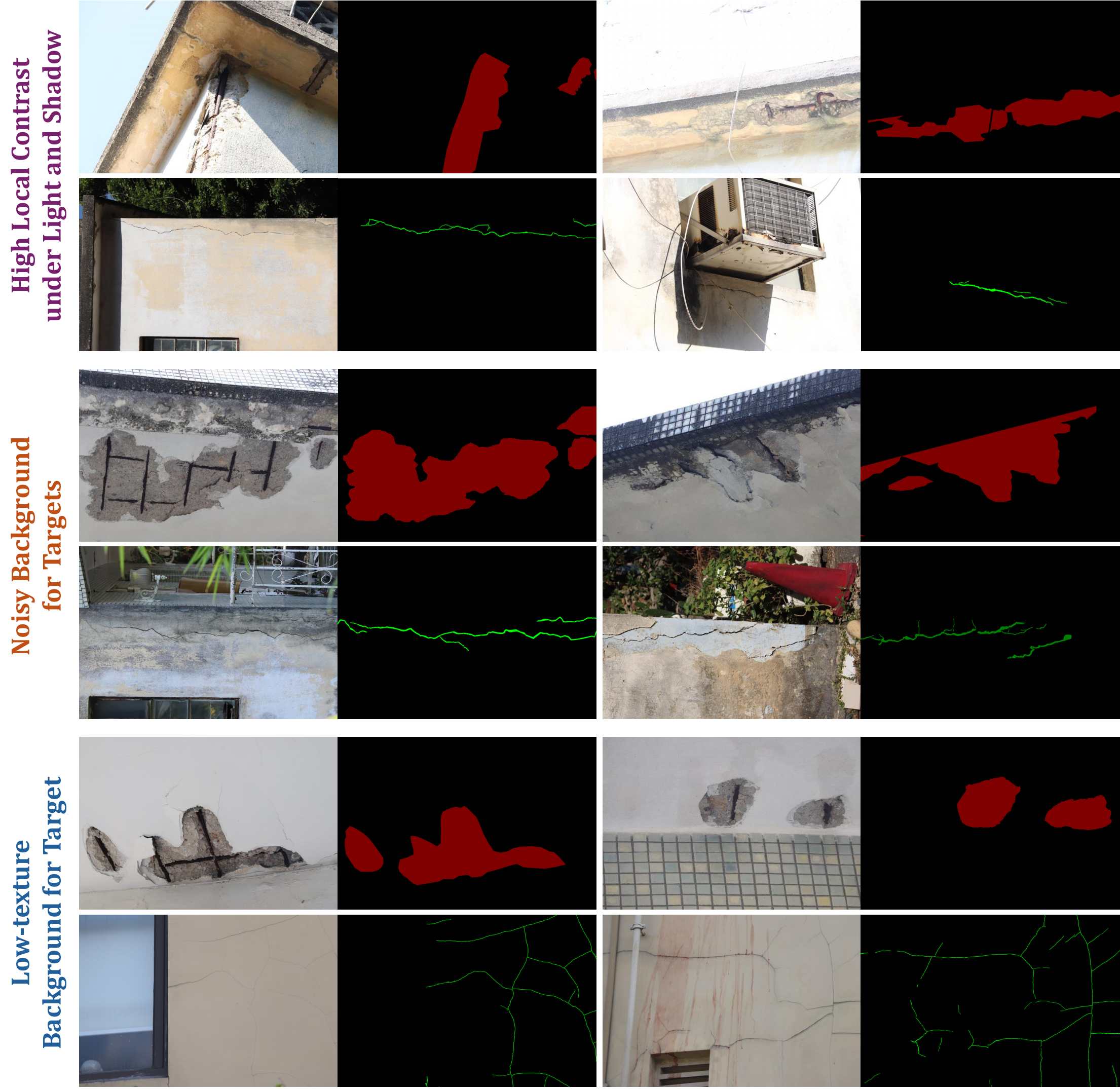
A condition report needs more than a box around a problem. Our model outputs a pixel-accurate mask for every defect, so cracks and spalling are measured, not just spotted.
Detection runs in two stages: a segmentation network localizes each defect, then a promptable segmenter (SAM 2) traces it to a clean per-pixel mask. From those masks we read a crack's width and a spall's area as real numbers, in mm and mm².
The hard part is never a clean lab crack. The model is trained and scored on the three conditions that break naive detectors:
Take a 1960s weatherboard cottage in Bracken Ridge. Here's the difference between a 50-photo PDF and a navigable 3D model with detection.
Every flight in the SafeDetect network is conducted by a licensed AU operator with current ReOC + public-liability cover. We verify both on onboarding.
COLMAP, gsplat, YOLOv11-seg, SAM 2: every component in the processing stack is Apache-2 / MIT / BSD licensed. No black box. No vendor lock.
Defect detection fine-tuned on AU building stock: weatherboard, brick veneer, render, Colorbond, tiled roof. Trained for what you actually have.
Faces, plates, neighbouring property auto-masked before processing. Source footage retained only for the inspection window, then purged.
PGSR mesh extraction gives 5-15 mm wall-error vs LiDAR ground truth. Good enough for a crack width or a spall area to be quoted in mm².
Capture, processing parameters and detection thresholds are all logged. Two inspections of the same property produce comparable, defensible numbers.
SafeDetect is a condition-detection product, not a substitute for a licensed building inspection. Always commission an AS 4349.1-certified inspector before contract exchange.
No. SafeDetect surfaces visible exterior + interior defects from imagery: what an inspector would see with eyes, just faster and georeferenced. We do not replace structural assessment, pest inspection, plumbing or electrical certification. Always commission an AS 4349.1-certified inspector before contract exchange.
Published benchmarks place facade-crack detection at ~88% [email protected], spalling at ~82%, corrosion at ~79%. Accuracy varies by lighting, capture angle and material. We surface confidence scores per detection so you can see when we are guessing. False negatives are possible: the operator and inspector review the model alongside the auto-flags.
Upload it. The processing pipeline accepts any RGB photo set or video from any drone: DJI, Skydio, Autel, custom. We extract camera poses via COLMAP, train the Gaussian Splat, and run defect detection on the source frames. No re-flight needed.
A browser link, mobile or desktop, works in Chrome / Safari / Firefox. Drag to rotate, scroll to zoom, click any defect marker for the source photo + AI confidence + your note. Shareable with your conveyancer, partner, builder, no app install.
Pure Gaussian Splat struggles with glass: view-dependent reflections create "ghost" Gaussians. We cross-check with a photogrammetric mesh for those regions and document the limit honestly in the report. Most AU residential is brick/weatherboard/render where this is not an issue.
Yes, that is one of our most valuable features. We capture the same property at 6 / 12 / 24 months and produce a "what changed" comparison: new defects, defects that worsened, defects that resolved. Same 3D scaffold; differential overlay.
You do. The customer who paid for the inspection owns the captured footage and the resulting 3D model. SafeDetect keeps a backup for 12 months for re-inspection eligibility, after which it is purged unless you opt in to retention.
Yes. Public-liability insurance is mandatory for every operator on the network, minimum $20M. We verify the certificate on onboarding and re-check at renewal. Any claim arising from a flight is handled by the operator's insurer; SafeDetect is the platform, not the flier.
Book a capture on one property. We'll walk you through the 3D model and the defects we find, no commitment.